Carcinization
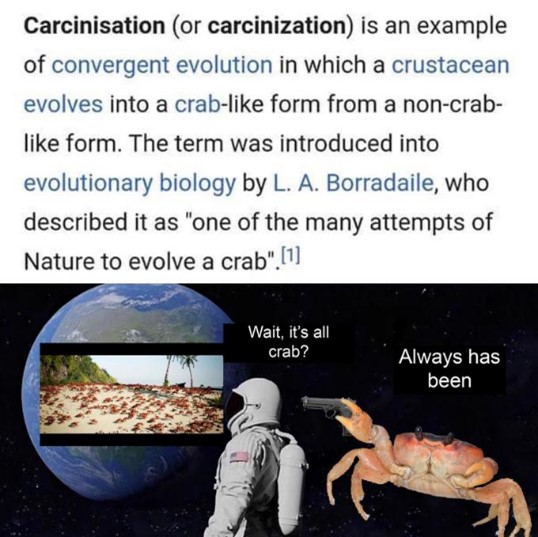
The repeated emergence of the crab-like form is known as carcinization. The term was introduced in 1916 by evolutionary biologist Lancelot Borradaile to describe the tendency of certain crustaceans to evolve toward a morphology resembling that of true crabs. Since then, carcinization has become an important concept in understanding convergent evolution and the developmental constraints that shape animal body plans.
What Is a Crab?
To understand carcinization, it is first necessary to clarify what scientists mean by "crab."
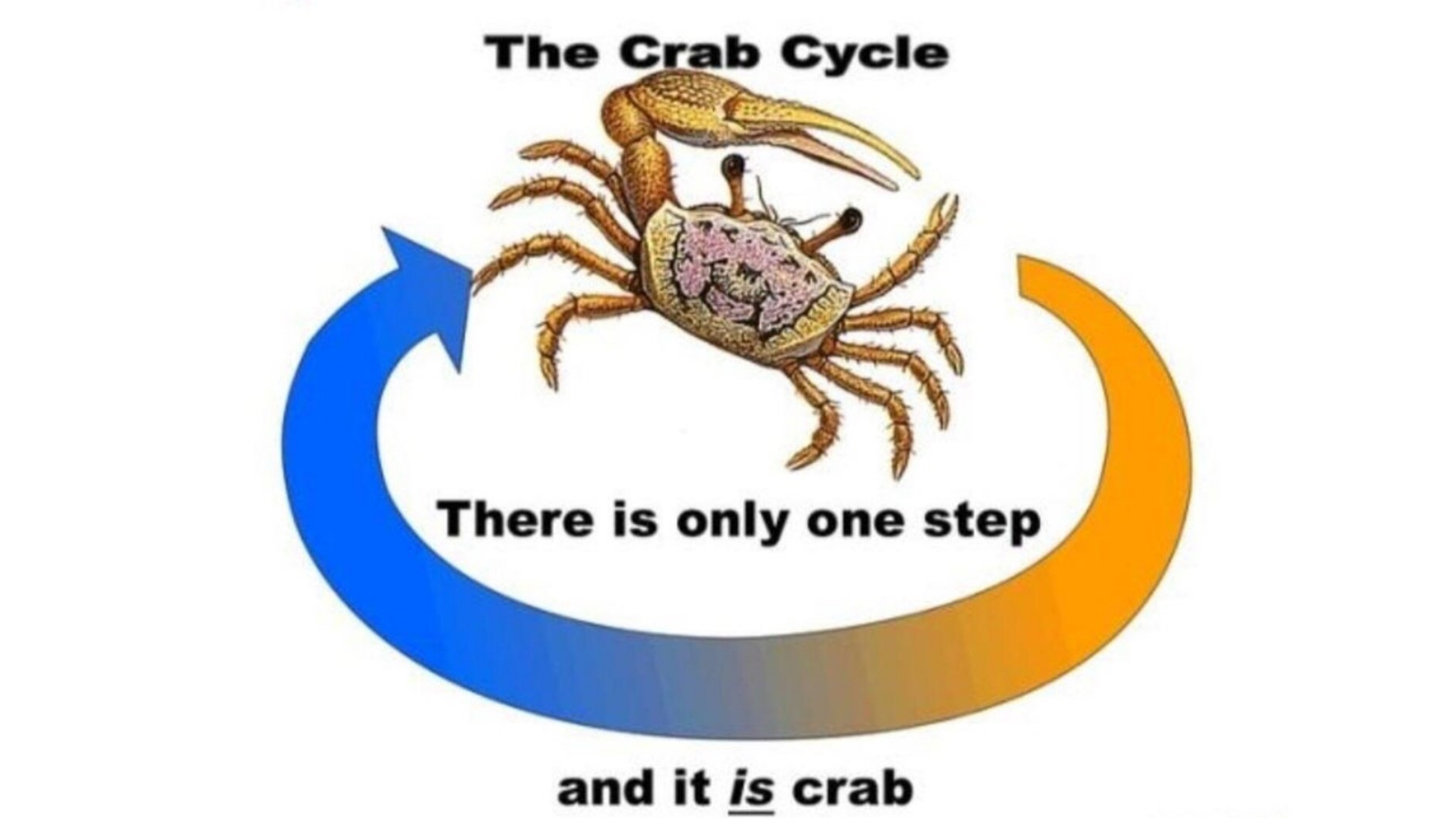
Crabs belong to the order Decapoda, meaning "ten feet," which includes animals with five pairs of thoracic limbs. They fall under the phylum Arthropoda, subphylum Crustacea, and the clade Meiura (Kazlev, 2022). Within this group, so-called true crabs are classified under the infraorder Brachyura.
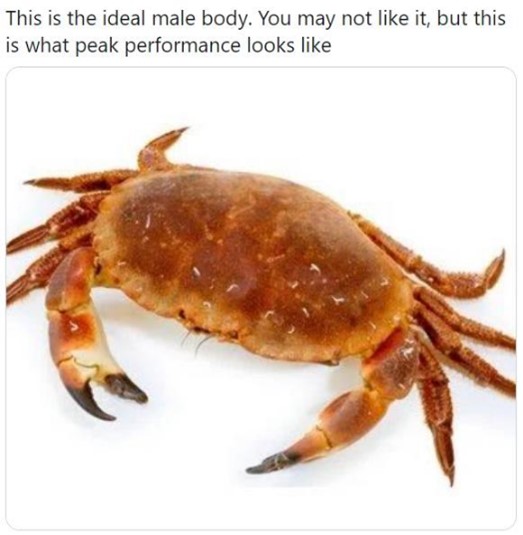
True crabs include familiar species such as blue crabs, ghost crabs, snow crabs, and the Japanese spider crab. They are generally characterized by a broad, flattened carapace; a greatly reduced abdomen (pleon) that is folded underneath the body; and four visible pairs of walking legs, with the fifth pair modified into claws.
What Is Not a Crab?
Many animals commonly referred to as crabs are not true crabs from a taxonomic perspective. These species are often called false crabs and are primarily found within the infraorder Anomura, a close relative of Brachyura.
Examples of false crabs include hermit crabs, porcelain crabs, coconut crabs, and king crabs. Although these animals resemble true crabs in shape, they typically differ in key anatomical features. Most anomurans have only three visible pairs of walking legs, with the fourth pair being reduced or hidden beneath the carapace. Many also retain a longer, less tightly folded abdomen, particularly in species such as hermit crabs, which use shells for protection.
Despite these differences, the superficial similarity between true crabs and false crabs is the result of convergent evolution rather than close ancestry.
How Does an Animal Become Crab-Like?
Carcinization is not a single change, but a suite of morphological transformations that occur over evolutionary time. According to Wolfe et al. (2021), the process typically includes several of the following traits: the carapace becomes wider and flatter; the abdomen (pleon) shortens and curls beneath the body; the tail fan seen in lobster-like ancestors is reduced or lost; and the ventral plates of the exoskeleton fuse together.
Not all species undergoing carcinization display every one of these traits. Some undergo partial carcinization, retaining ancestral features while adopting a more crab-like form. Hermit crabs, for example, maintain a soft, elongated abdomen while showing a widened carapace and shortened body plan.
Why Does Carcinization Occur?
The repeated evolution of the crab-like form suggests that it offers significant functional advantages. One major benefit appears to be protection. By tucking the abdomen beneath a rigid carapace, vulnerable body parts are shielded from predators, reducing the amount of exposed surface area.
Another advantage is mobility and flexibility. A compact, flattened body allows crab-like crustaceans to move efficiently across complex environments such as rocky shorelines, coral reefs, and narrow crevices. This body plan also enables quick lateral movement, which can be advantageous for both escaping predators and capturing prey (Green, 2020).
Why Do Scientists Study Carcinization?
Carcinization is a particularly clear example of convergent evolution, in which different species independently evolve similar traits in response to comparable environmental challenges. Because this process has occurred multiple times within crustaceans, it provides researchers with a natural framework for comparing evolutionary pathways.
Additionally, the frequent pairing of certain traits,such as a widened carapace and a curled abdomen,suggests that these features may be linked at a developmental or genetic level (Wolfe et al., 2021). Studying these links can help scientists understand how complex body plans evolve and how developmental constraints shape the range of possible forms an organism can take.
Beyond crustaceans, insights gained from carcinization may help biologists better predict evolutionary trends in other groups, shedding light on the broader rules that govern the evolution of life on Earth.
Sources
Green, H. (2020). Why Do Things Keep Evolving Into Crabs? PBS Eons. YouTube. https://www.youtube.com/watch?v=wvfR3XLXPvw.
Kazlev, M. A. (n.d.). Decapoda: Anomura. Palaeos Arthropods: Crustacea: Decapoda: Meiura. http://palaeos.com/metazoa/arthropoda/decapoda/meiura.html
Wikimedia Foundation. (2022, November 20). Carcinisation. Wikipedia. https://en.wikipedia.org/wiki/Carcinisation
Wolfe, J. M., Luque, J., & Bracken-Grissom, H. D. (2021). How to become a crab: Phenotypic constraints on a recurring body plan. BioEssays, 43(5), 2100020. https://doi.org/10.1002/bies.202100020